Thursday Oct 15, 2026
Thursday Oct 15, 2026
Thursday, 19 March 2026 02:45 - - {{hitsCtrl.values.hits}}
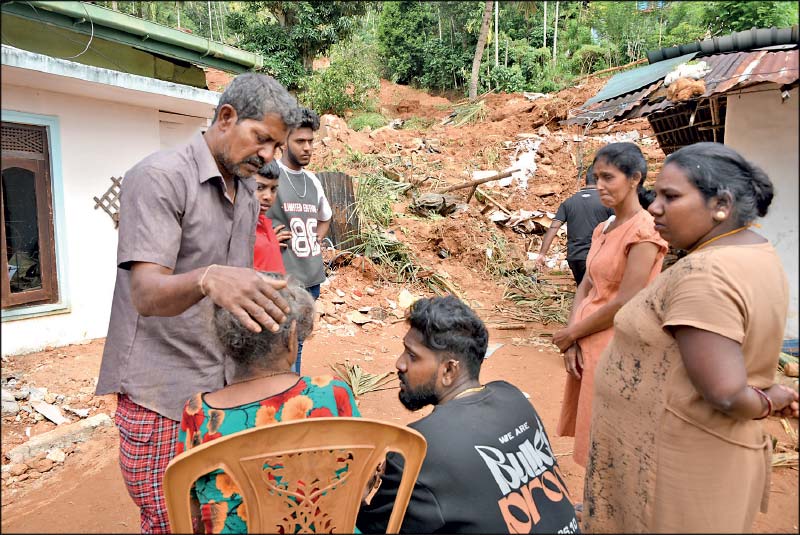
A family in Central Province grieve following damages to their house following the DITWAH cycle
 An era in which extreme events
The Indian Ocean Tsunami hit Sri Lanka in 2004. Cyclone Ditwah swamped us in 2025. In both cases, in addition to lives lost and damage, the economy took significant hits, and our popular answer to recovery and bouncing back is unreservedly appealing for help. We are also happy to claim that the latest disaster is worse than the previous one, and therefore, we deserve much more sympathy and support. Then the country›s leaders must spend a fair amount of time sitting down to discuss and standing up to ensure photo shoots with donors. The aid-dependency economy kicks into action with Dutch disease symptoms, and we must know that is not the way an economy should run. Events like Ditwah are going to be ever more frequent, and one can be quite sure of that. We are in an era in which extreme events will occur with greater frequency. We cannot afford to live with false hopes and statements that we are a mighty, resilient nation with forever-smiling faces and that we will be fine moving on.
Leadership should do what true leadership is expected to do – ensure the systems are made more resilient, and the public is more confident in facing up to such anomalies. Considering the concept of Total Defence is worth considering. Total defense is a whole society-oriented framework that Singapore has perhaps perfected. Total Defence is a comprehensive, whole-of-society strategy adopted to protect against both military and non-military threats by engaging all sectors—Government, military, businesses, and citizens. Primarily associated with Singapore›s national security framework since 1984, it focuses on building resilience to face crises, including pandemics, cyberattacks, and terrorism. The country expects the national economy to be resilient in managing such events with competence. Of course, the reason for these events to be ever more frequent must be addressed at a global level. It is an issue that is much talked about, with meetings held in many fine locations, yet the walk after all the talking was in the wrong direction. Well, the folly would be ours if we do not heighten our state of readiness, as we are a nation perhaps at the front line of climate risks in this part of the planet. Logistically, our position in the Indian Ocean offers significant strategic advantages, but the same position climatically creates strategic vulnerabilities. In adaptation, innovative minds are called for, and therein lies the lesson of this article.
 We cannot afford to live with false hopes and statements that we are a mighty, resilient nation with forever-smiling faces and that we will be fine moving on. Leadership should do what true leadership is expected to do – ensure the systems are made more resilient, and the public is more confident in facing up to such anomalies
Disaster and humanitarian aid management
Those who take up a distance learning course (DL 511) from WIPO Academy will encounter a case study on Sahana EDEN and the Sahana Software Foundation. Reading the GSMA application literature, one reads that the DEWN Early Warning System of Sri Lanka is described as a pioneering development. Sahana EDEN is presented as one of the world’s most popular open-source information management systems for disaster and humanitarian aid management. In the case of DEWN, the pioneering application status it has been granted is interesting to read about. Both these happened after the Tsunami, and that meeting of minds and action is a lesson for the future.
Cyclone Ditwah, moving through the country, caused death and destruction, and a current estimate puts the loss at $4.1 billion. Of course, the lives lost are much more poignant. It is a disaster that has left in its wake all kinds of discussions, almost always with political undertones, which is unfortunate, as that should not happen. Lively discussions continue to center on whether early warnings were issued. We are a nation used to receiving New Year greetings on our mobiles from the highest office of the country, indicating that reaching out is possible. A nation with more active SIMS than its population is witnessing its representatives going at each other’s throats over early warnings. The rest of the message is all about building better national resilience, etc., but the procedures in place all point to harnessing wish, write, ask, and collect strategies.
The greatest disaster is not the disaster but our collective failure to learn from it and follow up on developments. Due to such ignorance, we have fallen on the wrong side of the global performance metric. When considering early warnings, the Tsunami only had a 90-minute window between the earthquake and the arrival of the 1st wave in Sri Lanka. Earthquakes are events with almost no chance of being predicted at present. Cyclone Ditwah could have been an open book. The window for cyclone Ditwah was certainly much larger in terms of the time available for communication
Sahana and DEWN
Both Sahana and DEWN were conceptualised, developed, and deployed in Sri Lanka, and the trigger for these developments was the 2004 Indian Ocean Tsunami. In 2005, we were demonstrating early warnings and identifying what to do, etc., as a result of these pioneering ventures. Globally, when taking stock of extreme events and cumulative damage, it is clear that the number of events (i.e., disasters) has increased considerably, while the number of lives lost has decreased. This points to the success of early warning systems and readiness to face events. In 2004, with the experience, developments materialised into solutions to face future events. The DEWN app can still be downloaded to your mobile. Sahana is deployed in 30 plus countries as per the news coming from where it is currently based – California, United States. Twenty one years after that fateful event, we only say that this event is much worse than the tsunami. We are looking all around for sympathy.
Early warnings
The greatest disaster is not the disaster but our collective failure to learn from it and follow up on developments. Due to such ignorance, we have fallen on the wrong side of the global performance metric. When considering early warnings, the Tsunami only had a 90-minute window between the earthquake and the arrival of the 1st wave in Sri Lanka. Earthquakes are events with almost no chance of being predicted at present. Cyclone Ditwah could have been an open book. The window for cyclone Ditwah was certainly much larger in terms of the time available for communication. With DEWN using cell broadcasting, the one-to-many ability to get a message across to the masses should not have been an issue.
Sri Lanka is a signatory to the Sendai Declaration, and we have submitted our national assessments and action plans.
We must have participated in the global meetings. Decent gap analyses are available if you want to know what needs to be done, when, and where.
The issue that we must understand and put into place is that we appear to believe in administering an issue. It can be stated again – and I have repeated this many times – that our inability to understand and plan scientifically, and the importance of technology in enabling scaling solutions.
The Disaster Management Ministry (right now, this function is with the Defence Ministry) will operate in the same manner as the Ministry of Social Services. The same set of rules and circulars will apply whether the situation is a disaster or not. The Disaster Management Centre will have fewer powers than the Ministry to which it is connected. DEWN, interestingly, was a development of three parties – Dialog, Micro image, and the University of Moratuwa. The Lanka Software Foundation developed Sahana. These were products of inventive minds co-creating solutions of value. Products fit for the future. Sri Lanka had a chance to drive development and become an island of ingenuity in the real sense. Interestingly, the University of Moratuwa is still working on and adding to the DEWN – though the nation is oblivious to these developments.
Prof Dileeka Dias of the University of Moratuwa has been working with Prof. Raj Prasanna (Joint Centre for Disaster Research (JCDR) - Massey University, NZ) for the last few years on alternative last-mile communication technologies for disaster early warning and management.
Disaster readiness and management
One approach at the JDCR is to equip community members with low-power, long-range communication devices that can serve as both sensors and communication devices. As technology advances and developments such as AI emerge, solutions need to be updated, and more options are becoming available. These solutions are for disaster readiness and management. None of these has the capabilities to minimise events. To address this, more drastic interventions are needed, and there are global conventions for such measures. Sri Lanka, of course, has signed on to those conventions and almost with religious fervour participates in all meetings and submits national action plans.
It is with such understanding that the National Innovation Agency identified the Total Defence Approach as the way forward to ensure preparedness and readiness across all fronts. Of course, this was taking lessons from Singapore, Sweden, Switzerland and Finland. EWS is one of the most immediate and substantial tools to save lives in the face of climate change. The UN Office for Disaster Risk Reduction has calculated that every dollar invested in risk reduction and prevention can save $15 in post-disaster recovery. Another assessment by them is that a 24-hour notice of a hazardous event can cut damages by 30%.These recognitions have led the UN to launch the Early Warnings for All initiative, with the expectation that every person in the world will be protected by an EWS by 2027. Interesting to see that Sri Lanka has been way ahead in identification, development, and delivery post-2004.
The ensuing war with Iran by the United States and Israel, too, is likely to test our nation’s ability to learn from the past. The past here is managing fuel and flexible working – both interesting applications of available technology in circumventing impacts. Our greatest disaster has been not learning from the past and, as a result, reducing ourselves to finding solutions to the same old problem over and over again. A participating student in that WIPO course is expected to explain why Sahana is a good example of long-term economic growth resulting from open-source software development. Sahana and the long-term economic growth of which economy am I reduced to asking in 2025?




